Coming Soon
axiotrax computes your start line, your lift and knock, your target speed. All of it lives on a phone in a dry bag. The axiotrax device puts the numbers where you actually look — on deck, in sunlight, without touching anything.
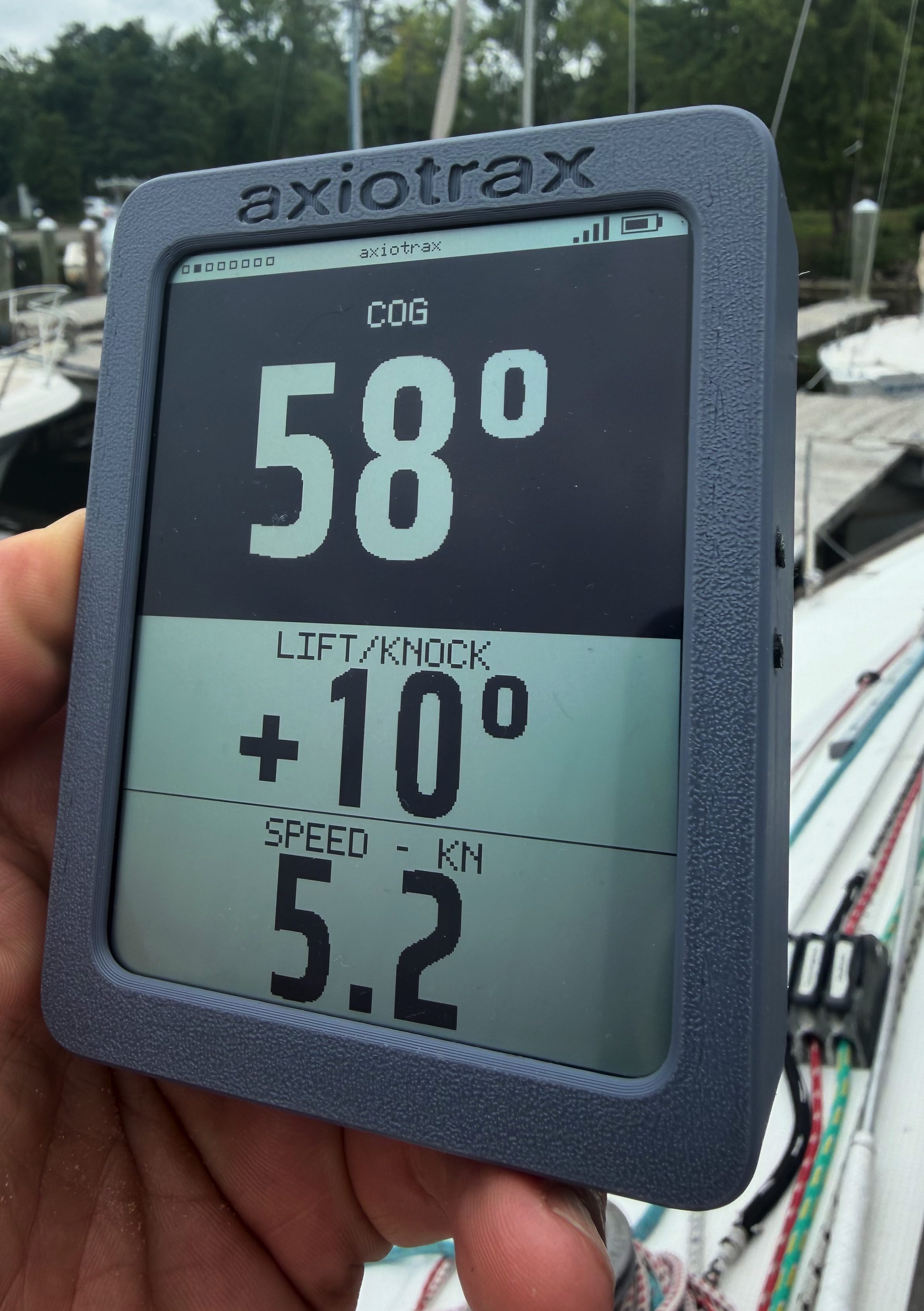
The panel is reflective, not backlit — it reads best in the light that defeats a phone.
Easier to show than to describe. This runs from the pre-start countdown into racing, then through a few of the pages you can put on the screen — axiotrax’s own numbers and whatever your NMEA instruments are reporting, side by side.
Nothing on screen is computed on the device. The phone works it all out and pushes finished numbers across, which is why the display never disagrees with the app in your pocket.
Filmed on the boat, not a simulator.
We are a software company, and we are not going to sell you hardware. But the hardest part of a sailing instrument is knowing what to show and when — and axiotrax already does that. What was missing was somewhere to put it that survives a wet cockpit and reads at arm’s length in full sun.
So the device is built from parts you can buy for about the price of dinner, the firmware is free, and the case prints on any hobby printer. You bring the hardware; the app brings the sailing.
The PCB is most of it, and that includes the display and battery. The rest is a case, a sheet of film and the patience to wait for a print.
| Part | Notes | Approx. |
|---|---|---|
| Waveshare ESP32-S3-RLCD-4.2 | One PCB — the 4.2″ reflective display and the battery are already on it | $40 |
| Printed case — STL files | PETG or ASA. Not PLA — a sunlit cockpit will soften it | filament |
| Quarter-wave polarizer film | Cut to the panel. Keeps the screen readable through polarised sunglasses. One sheet does 4–10 | $7 |
| 3M double-sided tape, 1 mm | High-tenacity. Bonds the film and mounts the unit — no fasteners. One roll does 4–10 | $7 |
| One unit | Buying everything from scratch | ~$55 |
| Each, building ten | The film and tape are already paid for | ~$42 |
The film and the tape are the only things that come in quantity, and one of each covers four to ten units. That makes a fleet cheaper per boat than a single build — a class set of ten is closer to $42 a unit than $55.
The board link is an Amazon affiliate link — if you buy through it we earn a small commission at no extra cost to you. Buy it anywhere you like; nothing about the build depends on where it came from.
Everything above is preliminary and being tested by a handful of people right now. If you are one of them, the things we most want to hear about are battery life over a full day and how the panel reads in glare with polarised sunglasses.
Everyone who sails with one arrives at the same answer within about ten minutes: the mast. It is where your eyes already go, it reads from the rail and from the helm, and it keeps the screen clear of everything else going on in the cockpit.
So we drew the brackets — two sizes covering most one-design and sportboat rigs, plus a mount for anyone already sailing with a Vakaros Atlas 2. All with room behind for the boom lines. They are free to axiotrax sailors.
The case files above are ready to print and free to anyone. The source CAD is a different thing: if you want to change the mount, fit it to a different panel, or design a version for your own boat, you need the model rather than the mesh.
We will hand those over, free, to people doing something real with them — builders, coaches, sailing programs, clubs, anyone teaching this. Send us a note saying who you are and what you have in mind. That is the whole application process; we just like knowing where these end up.
Plug the board into this computer with a USB-C cable and press the button. Nothing to download, no toolchain, no command line.
[dev] to the end of your name. The display controls are
still behind that switch while this is preliminary.
If no port appears when you press Install — unplug the board, hold the BOOT button down, plug it back in, then let go. That forces the chip into its download mode, and it will show up. You only need this if the board is unresponsive; a healthy one appears on its own.
Firmware 0.10.5 — for the Waveshare ESP32-S3-RLCD-4.2. A first install erases the board, including anything the vendor shipped and any pairing it already had. Later updates keep it. Nothing here is permanent either way: the board is always one flash away from whatever you want on it.
The beta is open
The display is a window onto what axiotrax is already working out. Install the app, record a race, and it will have something to show.
Building these with a junior program or a fleet? Email us — we would like to hear how it goes.